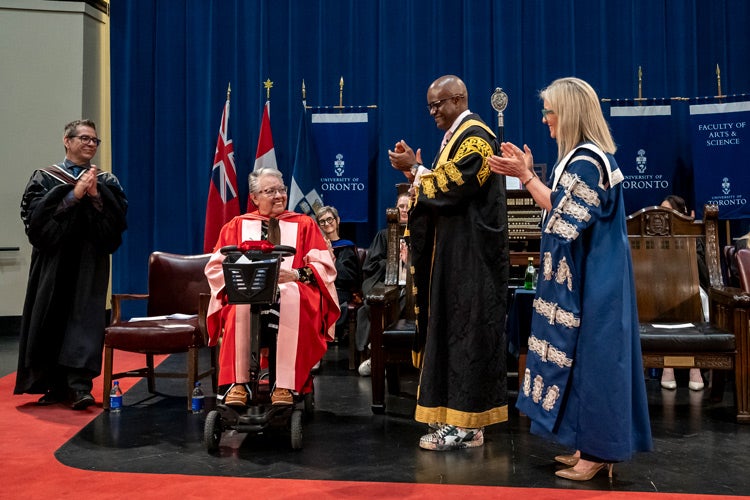
Eileen Antone receives U of T honorary degree for leadership in Indigenous education
(photo by Lisa Sakulensky)
Published: June 11, 2026
For Eileen Antone, education has never been simply about instruction. It is about restoring voice, reclaiming knowledge and creating space for Indigenous ways of being to thrive.
Today, in recognition of her outstanding service to the university, as a respected Elder, teacher and Knowledge Keeper whose wisdom, leadership and mentorship have profoundly enriched the university community, Antone receives an honorary doctorate from the University of Toronto.
A member of the Oneida of the Thames First Nation and of the Turtle Clan, Antone has spent decades shaping Indigenous education in Canada. As a U of T professor, her career has been marked by a deep commitment to Indigenous knowledge-making, language and learning grounded in community – work that has influenced generations of students, educators and researchers.
As a child, Antone attended the Indian Day School system in southwestern Ontario and later a secondary school in London, an educational journey that neither included nor valued Indigenous knowledge or experiences. Reflecting on that period of her life, she spoke candidly during a 2018 Toronto United Church Council Heart & Vision Concert Awards speech about the imposed and assimilative nature of the education system she encountered: “I only knew I was made to feel inferior.”
It was only later, through post-secondary education, that Antone began to encounter Indigenous scholarship and critically examine the systems that had influenced her early learning. Through her studies and research – including doctoral work at the Ontario Institute for Studies in Education (OISE) – Antone explored Indigenous knowledge systems and the impact of colonial policies on education. Her work has since focused on Indigenous literacy, knowledge systems and ways of being – with an emphasis on integrating these perspectives into both academic and community contexts.
At U of T, Antone held several key roles, including director of the Indigenous studies program and Centre for Indigenous Studies, as well as appointments in the department of adult education, community development and counselling psychology, and the Transitional Year Programme. In 2019, she was appointed special adviser on Indigenous affairs in the Faculty of Arts & Science and has served as an Elder on the dean’s advisory committee on Indigenous teaching and learning.
In these roles, she has advocated for creating space for Indigenous students, culture and knowledge on campus. By contrast, when she first arrived at U of T in the early 1990s, she said the Indigenous presence was minimal. “There was nothing here,” she recalled in a 2017 CBC interview.
Over the years, Antone has also pushed for greater support and visibility for the Indigenous students who are here. Seeing that change take shape has been meaningful: “That’s what my goal was – to be able to see as I see today, Aboriginal students here at the University of Toronto,” she told the CBC, reflecting on a campus powwow that brought hundreds together.
Central to Antone’s teaching and scholarship is the importance of oral tradition. “Storytelling has always [been] a significant part of life in our community,” she said in an article published on the website of the Sandy-Saulteaux Spiritual Centre – a way of sharing community knowledge and culture across generations.
Her work has also emphasized that Indigenous education is rooted in respect, continuity and the sacredness of life. Drawing on Indigenous teachings, she noted during her Heart & Vision remarks how traditional education was a continuous process from birth to death.
At the same time, Antone has not shied away from confronting the disruptions caused by colonialism and residential schooling. In the same speech, she described the historical imposition of Western education as “compulsory miseducation for another purpose” – one that broke the continuity of Indigenous knowledge and identity. Her scholarship and leadership have thus been grounded in the effort to restore that continuity, according to the Sandy-Saulteaux article – to “raise up traditional knowledge and ways of being.”
Beyond the university, Antone has contributed to social justice initiatives throughout Ontario and worked to ensure that Indigenous students have meaningful pathways into and through higher education. She has also emphasized the importance of preserving and using Indigenous languages, noting in her 2018 Heart & Vision remarks that they “carry the culture, values and beliefs” of a people.
Topics
Newsletter