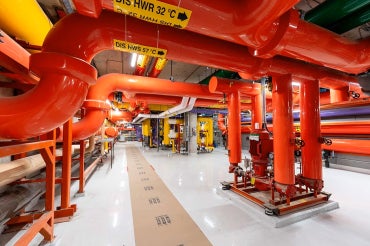
(photo courtesy of U of T Facilities and Services)
Published: February 3, 2026
By Kay Kelly
This month’s Campus Discovery challenge invites you to explore how the University of Toronto uses the earth as a giant thermal battery to heat and cool our buildings — one of the reasons we’re consistently ranked among the world’s most sustainable universities. It’s also one of the ways we’re building a more sustainable future.
Before we begin, thank you to everyone who entered our first U of T Bookstore challenge, and congratulations to our winners — U of T Mississauga's Patricia Chiasson, U of T Scarborough's Ryan Verma, and St. George’s Jenny Gnanasabesan (see photos in the Feb. 4 issue of The Bulletin Brief).
Now, back to our next challenge:
At U of T, the ground beneath us helps power a greener future. Our geothermal systems use deep boreholes (narrow shafts drilled hundreds of metres underground that transfer heat to and from the earth) to move thermal energy year-round, reducing emissions and transforming how we heat and cool our campuses.
This month, we invite you to visit one of the sites below, uncover the answer to the skill testing question, upload a selfie at the location and submit it through the link for a chance to win a Defy Gravity ceramic-lined, stainless steel bottle and matching hat. One entry per person. Contest closes Feb. 28, 2026.

Campus Discovery locations:
1. St. George — Landmark’s geoexchange system
Beneath King’s College Circle lies Canada’s largest urban geoexchange system — a massive underground thermal battery that helps heat and cool campus buildings while reducing reliance on fossil fuels. The system includes 372 boreholes, each roughly half the height of the CN Tower, that store heat in summer and return it to buildings in winter.
Where to go: At King’s College Circle, look for the glass pavilion on the southeast side of the lawn (in front of the Medical Sciences Building). Head down toward the Landmark parking garage to view the geoexchange display and mechanical room windows.
Skill-testing question: What colour is the pipe that helps melt snow at building entrances around King’s College Circle? Enter answer here.
2. U of T Mississauga — New Science Building
U of T Mississauga’s New Science Building is one of the most energy‑efficient biological and chemical laboratory facilities in North America. Beneath the surrounding landscape are 178 geothermal boreholes, each drilled to approximately 340 feet deep, that help regulate temperatures year‑round. Because the geoexchange system uses only a small amount of electricity to run pumps, it consumes much less energy than conventional boilers and chillers.
Where to go: You’ve learned what’s happening deep underground — now head upwards in the building to see how this site captures energy from a very different direction.
Skill-testing question: What type of other type of renewable energy source can be found at the New Science Building? Enter answer here.
3. U of T Scarborough — Environmental Science & Chemistry Building
The Environmental Science & Chemistry Building (ESCB) at U of T Scarborough is one of its most efficient academic spaces. Its geothermal field — more than 60 boreholes, each 210 metres deep — draws heat from the earth in winter and returns excess heat in summer, supporting a low carbon system aligned with U of T’s climate goals. Several earth tubes around the building help precondition outdoor air before it enters the ventilation system.
Where to go: Walk the perimeter of the ESCB and look for the visible earth tubes (large vertical metal and concrete cylinders).
Skill-testing question: How many visible earth tubes surround the building? Enter answer here.