U of T undergrad eyes figure skating gold at Milano Cortina 2026
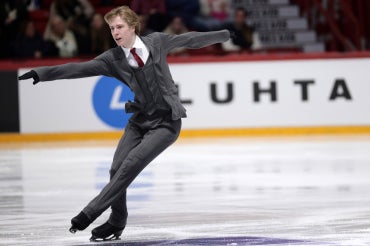
Stephen Gogolev, a U of T political science student and member St. Michael’s College, is set to make his Olympic debut at Milano Cortina 2026 (photo by Matti Matikainen/Xinhua via Getty Images)
Published: February 5, 2026
University of Toronto student Stephen Gogolev has a solid excuse for missing his midterms: there are no makeups for the Olympics.
When he takes to the ice at the 2026 Winter Olympic Games as Canada’s lone representative in men’s singles, Gogolev will mark an elite athletic milestone – not to mention a personal triumph over back problems that nearly derailed his skating career.
With a recent win at the national championships and a berth at the Olympics, the St. Michael’s College student now has his sights set on winning a gold medal at Milano Cortina – one of several members of the U of T community headed to Italy.
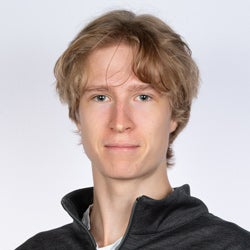
“I’m quite relieved, because this whole season has been leading up to this point,” says Gogolev, 21, a political science major. “And I’m happy that I made it – it’s fantastic.”
Born into an athletic family – his parents were gymnasts and his brother a competitive kayaker – Gogolev started skating at age six, although downhill skiing was his first love.
“When I was much younger, I had to make a choice to focus on one thing rather than both,” he says. “And I picked figure skating, which is a bit ironic because I was actually having more success in skiing. But I remember I was always obsessed with jumping, which I wasn’t really able to do when I was skiing.”
A prodigy, he landed a notoriously difficult triple axel at age 10. By 13, he became the youngest skater and first Canadian to land a quadruple lutz in competition, as well as the first Canadian to land three different quadruple jumps.
But a growth spurt at 15 years old saw him rapidly gain a foot in height, which triggered recurring back injuries that almost dashed his dreams.
“The Olympic Games were the biggest reason why I kept going and had hope,” he says. “In the past few years, when I was dealing with injuries, I thought I was at the end. But I always had that Olympic goal in my mind.”
With an eye on life after skating, Gogolev is equally focused on his political science studies.
“I believed political science would give me broader opportunities after graduation,” he says, adding that he’s thinking about a potential career in law or business.
He says a U of T course entitled “Principles of Economics for Non-Specialists” left an impression: “I really liked it, and it’s what made me want to pursue economics as a second major.”
Gogolev admits that balancing his studies with the rigorous demands of skating, as well as other beloved pastimes such as mountain biking and tennis, can be overwhelming, “Especially now, because I’ll be missing some tests and midterms while I’m away at the Games,” he says. “Overall, though, I think I’ve been able to find a good balance.”
Following in the grooves famed Canadian skaters Kurt Browning, Brian Orser and Elvis Stojko, Gogolev is a star of the “quad revolution” – the athletic mastery of ever-more difficult quadruple jumps in competition.
But his artistry is also evident – whether in his free skate program set to Rachmaninoff’s Piano Concerto 2, or his short program where he dresses as a prohibition-era gangster. For this Gogolev credits his choreographer, Benoît Richaud for encouraging him to carve out his creative edge.
“I think that’s been the biggest turning point so far in my skating career,” he says. “Ever since I started working with him, I’ve been able to bring out more of myself. I really enjoy his style of choreography and the way he’s able to bring emotions out of every skater he works with.”
Gogolev says that he enters a zone of concentration while performing that’s so intense, it’s hard to remember routines after he’s completed them.
His fans at the rink and watching at home have also keep him going. “The crowd support definitely gives you more energy to perform, compared to when you’re just training by yourself,” he says, adding that, after several difficult years, the warm response to his win at this year’s national championships (which were also the Olympic trials) was all the more fulfilling.
“It was quite an amazing feeling and one of the most special moments I’ve had.”
Read more about Stephen Gogolev at St. Michael’s College
Read about Varsity Blues alumni at the 2026 Winter Olympics
Topics
Newsletter