U of T grad student returns home to inspire Nunavut youth in STEM
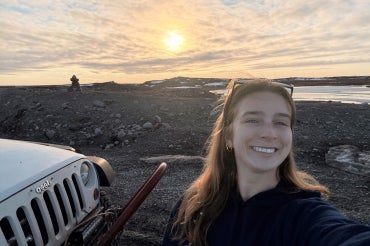
Shilo Chislett, a master’s student in the department of chemical engineering and applied chemistry, in her hometown of Rankin Inlet, Nvt., where she spoke to high school students about educational pathways (photo by Shilo Chislett)
Published: August 31, 2026
Shilo Chislett’s recent visit to Rankin Inlet, Nvt., was more than just a homecoming – it was an opportunity to inspire the next generation.
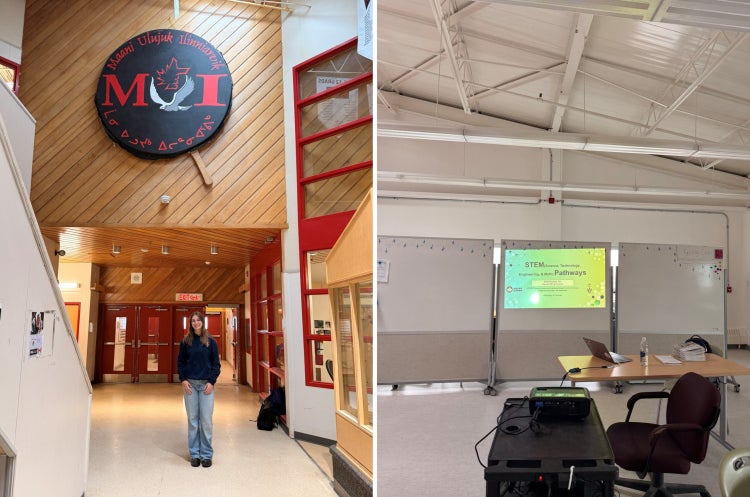
A master’s student in the University of Toronto’s Faculty of Applied Science & Engineering, Chislett travelled to her hometown this spring to speak with high school students at Maani Ulujuk Ilinniarvik (MUI) about STEM, higher education and other opportunities. Her visit was part of the Natural Sciences and Engineering Research Council of Canada (NSERC) Indigenous Student Ambassadors program, which supports Indigenous students in sharing their experiences and promoting STEM education within Indigenous communities.
Born in Rankin Inlet and raised in both Nunavut and later Stephenville, N.L., Chislett knows firsthand the challenges and opportunities that come with growing up in remote communities.
“I wanted students there to see someone who came from the same community and pursued higher education and research,” says Chislett, who is in the department of chemical engineering and applied chemistry.
“Sometimes opportunities can feel distant when you live in such a remote community, and I hoped that sharing my experiences would make those pathways feel more accessible.”
From remote communities to graduate studies
Chislett has long been interested in STEM and, in Grade 11, developed a particular interest in microbiology. That passion ultimately led her to U of T, where she completed double majors in molecular genetics and microbiology and immunology, along with a certificate in sustainability.
During her undergraduate studies, she became involved in research projects spanning infectious disease and environmental microbiology. She worked at the Emerging & Pandemic Infections Consortium, a U of T institutional strategic initiative, studying a bacterial protein involved in bovine respiratory disease, before joining BioZone in the department of chemical engineering and applied chemistry, where she researched bacterial-signalling regulation of the marine carbon cycle.
Those experiences led her to pursue graduate studies. Chislett, who is expected to graduate from the master of engineering program in October, says the interdisciplinary nature of her studies has allowed her to build on her interests in both environmental and health-related research.
Like many students transitioning from smaller communities to a large research-intensive university, Chislett says she initially found the adjustment challenging.
“I wanted students to know that there isn’t one perfect path into STEM,” she says, adding that she found her footing through mentorship, research opportunities and a strong support system. “I was honest about the challenges I faced during my transition.”
Creating pathways into STEM
Chislett says that growing up in a remote community can sometimes make future possibilities feel out of reach, which is why her presentation highlighted the scholarships, programs, mentors and support systems available to students after high school.
“Whether that’s university, trades, research or something else, where they come from doesn’t have to limit where they go,” she says, noting that her goal wasn’t to convince students to attend university or study STEM, but rather to broaden their understanding of the opportunities available to them.
It’s easier to imagine yourself in a role when you’ve seen someone with a similar background succeed in it
As part of the discussion, Chislett introduced students to research taking place in the North, including the Canada-Inuit Nunangat-United Kingdom Arctic Research Programme (CINUK), which focuses on climate change and health in the Canadian Arctic while incorporating Inuit knowledge and perspectives.
“What stood out to me most was being able to talk about research happening in the North and seeing how directly it connected to the students’ own community,” she says.
“It felt meaningful to connect broader scientific work to something that is directly tangible to them.”
The importance of representation
For Chislett, outreach initiatives like the NSERC Indigenous Student Ambassadors program play an important role in helping students see themselves reflected in STEM – something she says she would have benefited from when she was a high school student.
“Representation matters because it’s easier to imagine yourself in a role when you’ve seen someone with a similar background succeed in it,” she says.
She credits many mentors throughout her life – including family, teachers, professors, coaches and research supervisors – with encouraging her to pursue opportunities that shaped her own educational journey.
“I’m still learning myself, but if sharing my experiences helps a student feel more confident about pursuing their own goals, then that’s something I’m proud of.”
A meaningful homecoming
The trip also gave Chislett the chance to reconnect with the community where she was born. She spent time exploring Rankin Inlet, revisiting places from her childhood and reconnecting with family friends.
It was an emotional experience.
“Returning to my hometown really made me reflect on everything that has allowed me to be where I am today,” she says. “Being back in my hometown in a completely different role felt both surreal and meaningful.”
Chislett hopes her experience highlights the importance of building more meaningful pathways into STEM for Indigenous students and those from northern and remote communities.
“It’s about ensuring students feel supported, welcomed and empowered to succeed once they get there,” she says. “Talent exists everywhere; students from northern and remote communities have so much potential, and creating accessible pathways into STEM helps ensure that potential has the opportunity to grow.”
Topics
Newsletter