'Thanks for the Liver': U of T alumni share friendship — and a lifesaving gift
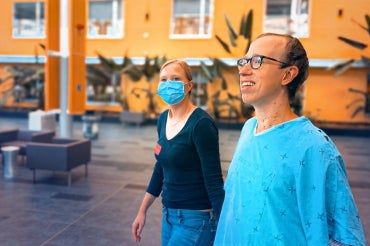
Fraser Allan Best and his partner Kathryn Pierce walk around the hospital post surgery. Pierce helped Best capture some of the documentary’s most emotional moments (image courtesy of Fraser Allan Best)
Published: September 19, 2025
Faculty of Arts & Science
University of Toronto students enjoy many benefits after they graduate: mentorship, career opportunities and lifelong friendships. For Fraser Allan Best, one of those friendships became a literal lifesaver.
In 2020, he received a transformative gift from friend and fellow alum Robbie Grant: a liver transplant.
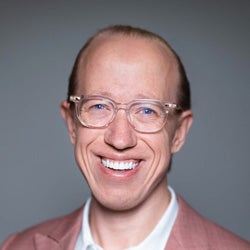
Best chronicles his remarkable journey from life-threatening illness to liver transplant and recovery in Thanks for the Liver, a new documentary premiering Sept. 20 at Toronto's Hot Docs Cinema. Made from more than 300 hours of candid video, it’s a personal film that captures the emotions and challenges of the experience.
“I’m not only in excellent health, but I’ve also achieved a quality of life that I never had before the transplant,” says Best, who earned his honours bachelor of arts degree in 2015 as a member of Victoria College.
Best was diagnosed at birth with glycogen storage disease (GSD) type 1b, which prevented his liver from producing essential sugars the body needs to function between meals. His genetic condition affects fewer than 100 people across Canada.
In 2017, Best worked as a journalist in Washington D.C. and had just accepted an offer for his dream job writing for his favourite magazine when his health started failing. Breathless, fatigued and constantly thirsty, he headed back to Toronto for medical care.
Doctors at the University Health Network ran a battery of tests leading to a stark diagnosis: his liver was throwing his body into chaos. Scans revealed scarring and tumours at high risk of turning into cancer.
Best needed a new liver or he was going to die. He was only 27 years old.
He turned down the job at the magazine.
Best’s parents volunteered as donors, but they were too old. His sister Kate would have agreed in a heartbeat, but she too was born with GSD –another hope dashed.
That’s when Grant entered the picture. He, too, had earned his honours bachelor of arts degree from U of T’s Faculty of Arts & Science in 2015, albeit as a member of University College. And the pair had run in the same social circles throughout university. After graduation, Grant and Best kindled a strong friendship stoked by debates and the knowledge they gained from their courses in philosophy and political science.
When he learned what his friend was going through, Grant didn’t hesitate to volunteer. Weeks later, doctors confirmed Grant’s liver was a perfect match.
“Fraser had a significant risk of death if he didn’t get the organ. For me, if I go through with the surgery, my risk of death is like a fraction of a per cent,” says Grant. “Even long-term serious medical complications from my surgery are extremely rare. It was clearly the right thing to do.”
In August 2020, Grant went under the knife. Doctors removed part of his liver and put it on ice. Grant was stable and expected to recover well.
Next, Best underwent a 12-hour surgery.
Initially, the transplant was a success, but Best developed a near-fatal infection that required another emergency surgery. Despite these complications, he was able to go home after just a few weeks.
The transplant cured Best's GSD. He’ll always have to take anti-rejection medication, but his life has forever changed.
“I joke with Robbie that I'm happy to be two per cent him, statistically, because my liver is Robbie’s DNA,” says Best, who met up with Grant and friends this past August to celebrate their five-year “transplantiversary.” They bashed open a liver-shaped pinata.
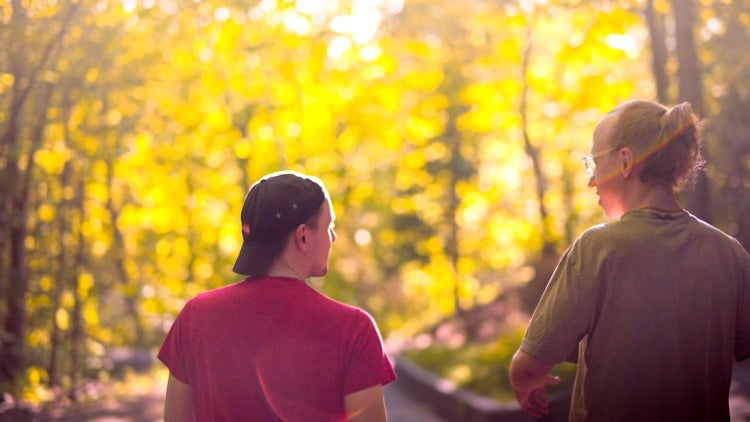
Grant and Best are both enjoying healthy lives. They’re eager for the premiere of Thanks for the Liver, the culmination of Best’s lifelong dream to become a filmmaker, which all began at U of T a decade before his transplant.
As part of Victoria College’s Vic One program, Best had been enrolled in the Jewison Stream, where he honed his creative storytelling skills and met the course’s namesake, the late Norman Jewison, an Oscar-nominated director and distinguished U of T alum.
“Having that experience was a beautiful thing at that time in my life,” says Best. “U of T allowed me to find a group of people oriented toward making things creatively. The more I think about it, the road to this documentary really has its roots in that first year at U of T.”
For Grant, the decision to donate has become about much more than saving one friend's life. He hopes the film will have a ripple effect, inspiring people to help others in all kinds of ways.
“We don’t have that many opportunities to do really good things in life – truly noble things,” says Grant, who graduated from U of T’s Faculty of Law in 2020.
“I hope people watching the film think about taking that opportunity to do something meaningful for another human being.”
Topics
Newsletter