From study permits to finding community: How international students thrive at U of T

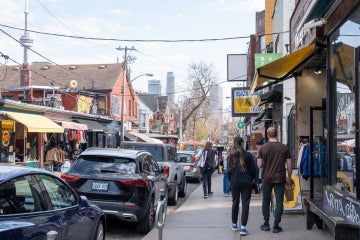
Nathan Alston, a first-year student from the Cayman Islands, says he's found both support and community at the University of Toronto (photo by Lisa Lightbourn)
Published: December 15, 2025
When Nathan Alston toured the University of Toronto’s St. George campus in May 2024, the diversity of the student body stood out immediately.
Originally from the Cayman Islands, Alston had spent two years at UWC Maastricht, an international school in the Netherlands, and was seeking a global community.
“I really appreciate U of T in terms of having that diverse student body,” said Alston, now in his first year of pursuing a double major in economics and physiology at the Faculty of Arts & Science.
He also appreciated some help he received along the way. When the fall semester was fast approaching and Alston still hadn’t received government approval for his study permit, he says staff at U of T’s Centre for International Experience and Victoria College's international orientation helped him begin classes on time.
“They told me about an expediting process,” he said. “Otherwise, I think I would have just kept waiting.”
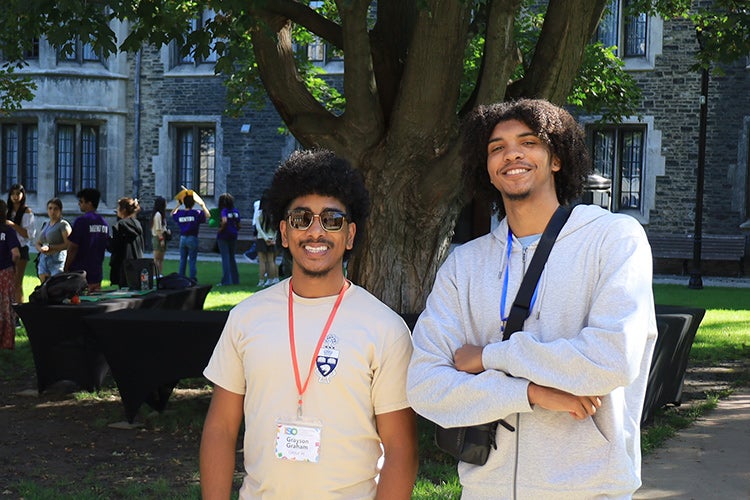
That Alston’s study permit was approved isn’t surprising. The approval rate for study permits for international students accepted by U of T sits at 88 per cent – the highest in the country and well above the national average of 54 per cent, says Joseph Wong, U of T’s vice-president, international.
“That’s really a testament to the strength of the international students U of T admits,” Wong says. “We see this in the ways these students enrich our campuses inside and outside the classroom, as well as in the high graduation rates they achieve.”
It’s also a testament to the supports the university has put in place, he adds. That includes hubs on each campus (International Education Centre at U of T Mississauga, Centre for International Experience on St. George and International Student Centre at U of T Scarborough) as well as 15 certified immigration advisers across the three campuses who guide students through applications, explain permit conditions and clarify work authorizations – and a wide array of resources once students have arrived, from health insurance to housing.
Understanding recent changes
Changes to government-issued study permits for international students have made headlines recently, but the targets – part of the federal government’s plan to manage the overall temporary-resident intake – aren’t expected to affect international students accepted to U of T, says Wong, a professor in the department of political science and the Munk School of Global Affairs and Public Policy in the Faculty of Arts & Science.
“U of T continues to use our full allocation of Provincial Attestation Letters, which is the process through which the federally set targets are allocated, and in the past we’ve received additional ones when needed,” Wong says.
“We’re moving ahead with the same intake plan we had before the federal budget announcement, and our teams continue to provide robust support to students preparing their study permit applications.”
Last year, that support included more than 6,600 individual appointments for students on all three campuses with U of T’s immigration advisers, as well as more than 10,000 email conversations, a series of webinars, information sessions and online Q-and-A drop-in hours. And, starting this year, U of T is offering personalized support in applying for study permits in the form of dedicated immigration advisers. U of T will provide admitted students with the email address to reach their adviser as soon as they receive their offers of admission, giving prospective undergrads from outside Canada a direct point of contact.
“We know that certain supports need to be in place for international students while they transition to a new country and throughout their time at the university,” said Wong. “And U of T is strongly committed to providing that support every step of the way.”
Support at every stage
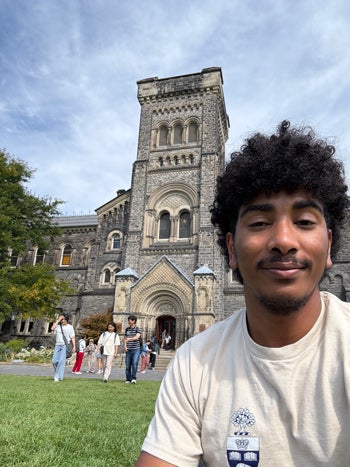
Like Alston, Grayson Graham found himself turning to U of T staff for support as the semester start date neared. He learned that when their start dates are approaching, students can flag their application for the IRCC via a special web form – and the American was soon on his way to Toronto.
“I went to the Centre for International Experience, and they helped me navigate contacting the IRCC,” he said. “I was able to apply for a request to expedite my study permit processing.”
Graham had originally planned to stay in the U.S. and attend a top university – but says once he turned his sights on Canada, U of T’s orientation and offerings helped him decide.
Now a first-year student, minoring in bioethics and psychology and majoring in public health at the Faculty of Arts & Science, Graham says the atmosphere of the St. George campus and the access to the city made U of T the clear choice.
“I toured it during spring finals – the cherry blossoms had sprung and Robarts looked gorgeous,” he recalled. “It was just lively. I loved the accessibility to transit and being right downtown. It was a no-brainer for me.”
Both Alston and Graham say that, alongside support, they’ve also found community at U of T.
Alston joined two intramural sports teams – basketball and ultimate frisbee, which he’d never played before coming to Toronto – plus a club affiliated with his former international school.
“You have to take your own path to make connections,” he said. “There’s so many student clubs, office hours for professors – it’s almost impossible not to make friends if you really want to.”
For his part, Graham joined the a capella group U of T Surround Sound, serves on the Victoria University Students' Administrative Council and frequents Hart House for concerts and events.
Both students remind international students that there are supports available and encourage them to connect with peer mentors during orientation.
“Reach out to people – specifically the Centre for International Experience – because they will be very helpful in the process,” said Graham. “And then seek out communities that fit your identity.”
Topics
Newsletter