With a passion for sci fi, U of T undergrad finds her calling in space policy
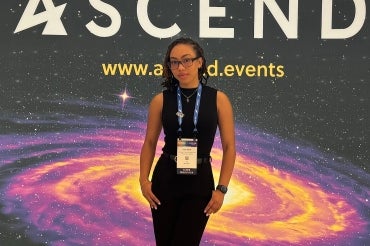
Leah Wolfe, an undergraduate student at U of T Scarborough, recently presented research along with the U of T Aerospace Team at the 2024 American Institute of Aeronautics and Astronautics (AIAA) Aviation Forum (supplied photo)
Published: November 6, 2025
As a child, Leah Wolfe was captivated by the characters and worlds of science fiction novels like Douglas Adams’s The Hitchhiker’s Guide to the Galaxy and Frank Herbert’s Dune.
Yet, the idea of pursuing career in space studies seemed as distant as the galaxies she read about.
“You read sci-fi as a kid, but I never thought of it as anything more than fantasy or something engineers do,” says Wolfe, who is now a fourth-year political science specialist at the University of Toronto Scarborough.
While Wolfe began her undergraduate studies planning to become a neurosurgeon, her focus soon swung to political science. At the same time, she carried a worn copy of Carl Sagan’s Cosmos everywhere she went – a book that helped her grasp “the technical side of space.”
Her evolving academic journey reached a critical juncture – one that would lead to her current focus on translating space data and science into policy and law – when she reached out to the U of T Aerospace Team.
“[I] emailed them about joining a project,” Wolfe says. “It reinvigorated my love for politics and for bridging two fields that don’t seem interconnected at all.”
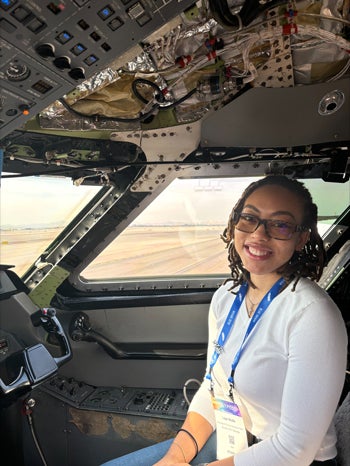
Founded in 2004, the University of Toronto Aerospace Team (UTAT) is an award-winning interdisciplinary network of undergraduate and graduate students who design and build drones, rockets and satellites – and promote aerospace sustainability through policy and law.
As a member of the team, Wolfe has researched aerospace policy through the lens of environmental outcomes.
Last year, the team travelled to Nevada to present their research to academics, space-defence specialists and industry professionals at the American Institute of Aeronautics and Astronautics (AIAA) Aviation Forum.
The study, published by the AIAA, examined how the U.S. Federal Aviation Administration’s (FAA) drone regulations affect the potential for trucks and unmanned aerial vehicles (UAVs) to work together in last-mile delivery. It focused on energy use and sustainability, as well as issues such as safety, data privacy, public perception and environmental factors.
Using computer modelling, the researchers found that while UAVs could make deliveries greener, current rules and impacts – including noise pollution and wildlife disturbances – limit their benefits, highlighting the need for smarter regulations and improved technology to make drone delivery more sustainable.
FAA rules currently allow small commercial drones to fly as fast as 160 kilometres per hour. But the UTAT team’s model found that the speed would ideally be much lower. For a drone weighing 13 kilograms and carrying a small load of up to two kilograms of cargo, the ideal speed is between 72 to 90 kilometres per hour.
“We found that maximum ground speed regulations provided by the FAA were greater than what is optimal for energy usage,” Wolfe explains. “Public acceptance of drones is also a major hinderance to widespread integration, which directly affects companies that wish to use them for last-mile delivery.”
Wolfe notes that FAA regulations could guide private companies in improving drones’ energy efficiency.
“Our recommendations demonstrated that you could lower a lot of these thresholds,” Wolfe says. “You’d still be able to have very accurate, efficient deliveries while also not using too much energy.”
The forum was Wolfe’s first international conference. She remembers buzzing with excitement and, naturally, a bit of anxiety.
“When you are surrounded by so many people who understand the depth of the technical side, and you’re the only political science or policy person, you start thinking, ‘Am I out of my depth?’” Wolfe says. “Afterwards, a woman who worked at NASA for 20 years came up to me and said, ‘You did amazing and you should always have confidence in yourself.’ That was so reassuring.”
Amid a busy schedule, Wolfe also supports initiatives that elevate other Black scholars.
She is a student organizer of the recent Possibilities & Refusals in Black Canadian Studies Symposium. Hosted by the Black Canadian Studies Association and led by Nicole Bernhardt, an assistant professor of political science at U of T Scarborough, the event celebrated the launch of the Journal of Canadian Studies special issue: “Nah! On the Possibilities of Ongoing Refusals in Black Canadian Studies.”
Wolfe also mentored local youth through the Imani Black Academic Mentorship Program, which promotes access in higher education for Black students in the Scarborough community. An Imani Mentor of the Year Award recipient, Wolfe supported Grade 7 and 8 students with tutoring and guidance on education and career planning.
With her sights set on graduate school to continue her studies in space law, Wolfe credits her time at U of T Scarborough for shaping both her academic focus and commitment to community.
“The U of T Scarborough community is so close-knit,” Wolfe says. “The community and opportunities I’ve had here has made it one of the most fulfilling four years of my life.”
Topics
Newsletter