Meet two U of T community members supporting Team Canada at the Winter Olympics and Paralympics

From left: U of T alumni Mireille Landry, a sport physical therapist with Skate Canada, and Michael Lenart, a physical therapist with Hockey Canada's national para hockey team (supplied images)
Published: February 10, 2026
From coaches to physicians and other support staff, it takes a literal village to keep athletes performing at peak levels at both the Winter Olympic and Paralympic Games.
As part of Team Canada’s support team at Milano Cortina 2026, University of Toronto alumni Mireille Landry and Michael Lenart are using their rehabilitation sciences expertise to give the country’s winter sport stars their best shot at the podium.
Here's how the two sport physical therapists plan to help Canada’s top athletes stay healthy, resilient and competition-ready on the world stage.
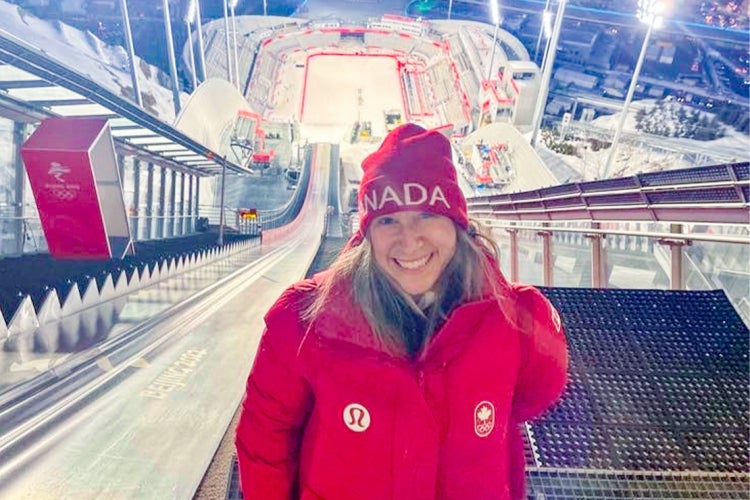
Mireille Landry
Landry is at the Winter Olympics as the sport physical therapist with Skate Canada, the national sport organization that represents Canadian figure skating. She will support athletes competing in ice dance, pairs and men’s and women’s figure skating.
A graduate of the Rehabilitation Sciences Institute and lecturer in the department of physical therapy at U of T’s Temerty Faculty of Medicine, Landry has worked with Skate Canada for more than a decade. During that time, she has built longstanding connections with some of Canada’s top figure skaters as they progressed through the ranks.
“I have created some good relationships over the years with many of these athletes – either through therapeutic relationships and treatments, or in a more supportive role,” Landry says. “Our relationship often starts when they’re young from a prevention and education standpoint – such as proper warmups and injury management.”
When the athletes get older, therapy becomes a bigger part of their ongoing maintenance, Landry says. “Even if they are not injured, they require a lot of therapy to sustain high-level performance.”
Landry notes that figure skating is a decentralized sport, meaning athletes on the Olympic team will train locally throughout the year. She steps in to support them at national and international Skate Canada events.
Landry credits her postgraduate training in sport physiotherapy from Sport Physiotherapy Canada, a division of the Canadian Physiotherapy Association, for her career supporting high-performance athletes and sport.
When she is not attending the Olympics, she works in cardiac rehabilitation at Women's College Hospital, provides consultation privately and through the Canadian Sport Institute Ontario and is a clinical instructor.
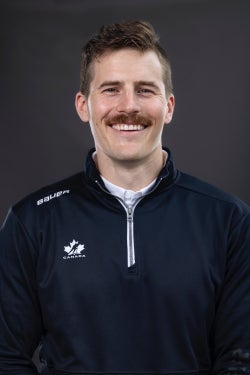
Michael Lenart
Lenart is going to the Winter Paralympics as a physical therapist with Hockey Canada's national para hockey team. A graduate of the master’s degree program in physical therapy at Temerty Medicine, he holds a diploma in sport physiotherapy and is a certified high-performance practitioner with Sport Scientist Canada.
Lenart has been a member of the Hockey Canada national para hockey team’s integrated support team for the past seven years. Currently, he works alongside a sports medicine physician, athletic therapist, sports dietitian, mental performance coach and a strength and conditioning coach. The support team meets regularly throughout the season to ensure these Paralympic athletes receive the support they need to compete at the highest level.
“A lot of what we do is geared toward facilitating a high-performance environment, Lenart says. “One of our strengths as a support team is being able to support the vision of the organization and use our respective fields of study to help develop high-performance athletes.”
In para hockey, athletes are prone to forearm, wrist and shoulder injuries, Lenart notes. “Being able to collaborate throughout the season as a support staff to adapt an athlete’s daily training environment is essential in maximizing their health and performance,” he says.
Lenart became interested in working with special populations when he was a physical therapy student at U of T doing a placement at Toronto Rehab – Lyndhurst Centre, working with people who had spinal cord injuries and related neurological conditions.
He says that working in para sport is one of the best tests for understanding how concepts taught in the classroom can be modified to an individual athlete’s needs.
“These athletes and what they’ve overcome – whether it’s a congenital birth defect, a spinal cord injury, an amputation or being a cancer survivor – are the epitome of human resilience,” Lenart says. “Being able to support these individuals and work toward the common goal of winning a gold medal for Canada is extremely rewarding, and something for which I’ll be forever grateful.”
When Lenart is not traveling to support the para hockey team, he works at a clinic in Newmarket, Ont., where he provides physical therapy to the general public and local athletes.
Topics
Newsletter