Mason White appointed dean of U of T’s John H. Daniels Faculty of Architecture, Landscape, and Design
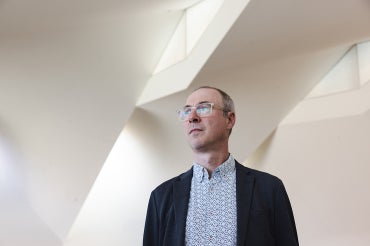
(photo by Polina Teif)
Published: April 23, 2026
Mason White, an award-winning scholar and designer, has been appointed dean of the University of Toronto’s John H. Daniels Faculty of Architecture, Landscape, and Design.
A faculty member at Daniels since 2005, White is an expert in architecture, urban design and the relationship between architecture, environment and society – with a focus on cold climates.
He will assume his new role on July 1, 2026 for a five-year term. His appointment was approved Wednesday following an extensive international search.
“Having taught here for 20 years already, it is an incredible honour to have the opportunity to support our students, faculty and staff as they pursue even greater heights,” said White. “I’m really excited for the challenge ahead and for the future of this faculty, which brings together a remarkable diversity of perspectives across disciplines and practices.”
White is renowned for his research, architecture and design work in cold environments and across scales – from individual buildings to entire cities and regions. A founding partner of Lateral Office, an interdisciplinary design practice, White often collaborates with Indigenous partners on community‑empowering research and design projects.
He has held several leadership roles at Daniels, including director of the master of architecture and master of urban design programs, as well as the post-professional master of architecture and master of landscape architecture programs.
Trevor Young, U of T’s vice‑president and provost, congratulated White on his appointment.
“Professor White’s commitment to research and practice excellence will be key to the continued success of the John H. Daniels Faculty of Architecture, Landscape, and Design in the years ahead,” said Young.
“His scholarly vision and collaborative focus will guide Daniels students and faculty in exploring innovative ways to shape the spaces and experiences that enrich our lives, and in responding thoughtfully to social and environmental challenges.”
Young also thanked Professor Robert Levit for his exceptional service as acting dean since August 2023.
A Fellow of the Royal Architectural Institute of Canada, White has served as a primary investigator and collaborator on several major arts and tri‑council grants – with more than $2.4 million in funded research – and has lectured and exhibited extensively across the United States, Canada, South America, Europe and Asia.
He is the founding editor of the journal Bracket, co-author of Many Norths: Spatial Practice in a Polar Territory, co-editor of Third Coast Atlas: Prelude to a Plan and has had his work and writing featured in major newspapers, magazines and journals.
With bachelor’s and master’s degrees in architecture from Virginia Tech and Harvard University, respectively, White said Daniels’ evolution – from a school of architecture, landscape architecture and urban design to a faculty that also includes forestry and visual studies – puts it in a unique position to perform high-impact interdisciplinary work.
“There are powerful overlaps between disciplines that are all hosted under one roof here – literally,” said White, who has received multiple awards for his work – both personally and via Lateral Office.
“From realms like forestry and landscape architecture, whose connections are obvious, to less apparent – yet promising – links between urban design and visual studies, we can combine how these disciplines have traditionally worked while examining their shared interests.”
As dean, White said he is eager to strengthen relationships with Daniels alumni and foster new research partnerships at U of T and beyond – all while emphasizing collaboration, creativity and community engagement.
“We want to support and train design leaders who are collaborative and creative,” he said. “That means finding a balance between the technical skills that students need and the human, community‑facing leadership the world requires.”
Topics
Newsletter