Gregory David receives U of T honorary degree for leadership in philanthropy
(photo by Tobias Wang)
Published: June 17, 2026
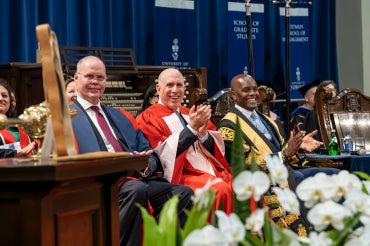
(L-R) Adalsteinn (Steini) Brown, Gregory David and Chancellor Wes Hall (photo by Lisa Sakulensky)
Across a career that spans finance, governance and philanthropy, Gregory David has focused on a consistent goal: building institutions that can serve more people, more effectively over the long term.
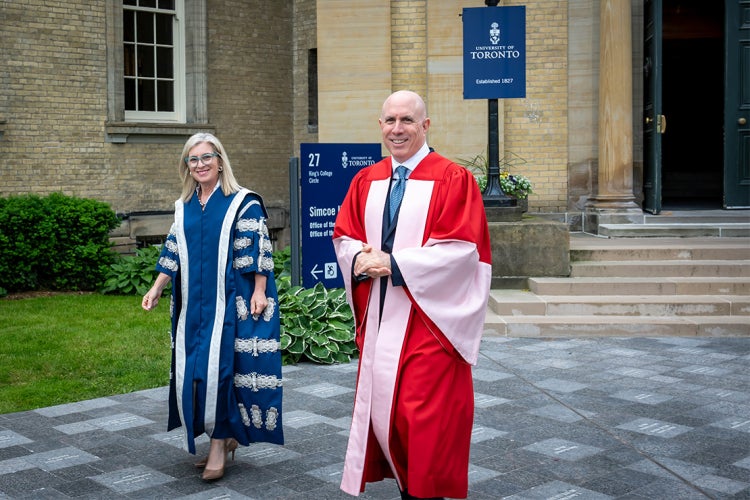
Today, in recognition of his outstanding service to the public good, through leadership in philanthropy that has strengthened health care, education and mental health resources within Canada’s universities and academic health institutions, David receives an honorary doctorate from the University of Toronto.
David is chief executive officer of GRI Capital Inc., a role he has held for more than two decades, and a corporate director, serving on the boards of Dollarama and Roots. Alongside his work in business, he has been deeply engaged in several philanthropic initiatives.
After beginning his career in consulting and investment, David later advised Canadian companies on mergers and acquisitions before joining Dollarama as a senior executive. He founded GRI Capital in 2005, applying an approach grounded in corporate discipline, good governance and a focus on long-term strategy.
That same perspective has defined his philanthropic work. As executive chair of the Rossy Foundation and chair of the David Family Foundation, David has helped formulate a model of giving that focuses not only on programs, but on the underlying structures that allow institutions to build greater impact. His work has supported initiatives across health care, mental health, education, the environment and community services, among others.
That impact is especially evident in post-secondary mental health. Through the Rossy Foundation, David has supported national efforts to improve student well-being, including initiatives that connect universities to share best practices and expand access to campus-based services. At U of T and other institutions, this work has fostered leadership, research and the development of evidence-based approaches to providing mental health support.
David’s approach reflects a belief that philanthropy should address root causes rather than symptoms – investing in leadership, infrastructure and data systems that enable organizations to operate more effectively over time.
That belief is also evident in his broader support of health-care innovation. The foundation has contributed to initiatives that improve treatment options and clinical care, and strengthen research capacity in both Montreal and Toronto, including programs focused on rare or complex diseases and underfunded areas of care.
A graduate of Queen’s University, McGill University’s Faculty of Law and Harvard Business School, David has spoken about the importance of giving back. “The world and community we are part of were built by those who preceded us,” he told Queen’s in 2017. “We are fortunate enough to have the opportunity to do the same for those who come after us.”
In backing student mental health initiatives, David has emphasized the importance of ensuring that students have the resilience and support they need to make the most of their university experience.
Beyond health and education, his philanthropic work has extended to civic engagement, journalism and community development, supporting initiatives that strengthen democratic resilience and expand access to opportunity for young people.
For example, David played a key role in supporting local journalism during the 2025 federal election. What began as a conversation between him and Public Policy Forum Chair André Beaulieu quickly led to a fund – launched by the PPF, Rideau Hall Foundation and Michener Awards Foundation with a lead gift from the Rossy Foundation – that ultimately supported election coverage efforts at more than 40 local outlets from coast to coast. One recipient described the effort to the Philanthropist Journal as a “model for how public-service journalism is supported in this country.”
David’s contributions have been recognized with several honours, including the E.P. Taylor Award from McGill University and the John B. Stirling Montreal Medal from Queen’s University.
Topics
Newsletter