Filmmaker and PhD candidate aims to improve the on-screen portrayal of trans people
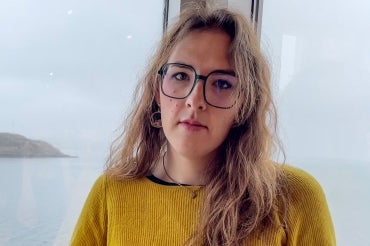
A PhD candidate at U of T’s Cinema Studies Institute, Petra Totten is an award-winning filmmaker with works appearing at festivals across Europe, Asia and North America (supplied image)
Published: September 4, 2025
Faculty of Arts & Science
Petra Totten says most trans stories follow a tired formula and are rarely told for a trans audience – something she’s hoping to change.
Now a PhD candidate at the University of Toronto, Totten is an award-winning filmmaker whose works have appeared at festivals across Europe, Asia and North America.
Her research is based at the Cinema Studies Institute in the Faculty of Arts & Science.
“My specific interest is in the representation of trans people in non-fiction and documentary media,” she says. “I want to infuse more care and artistry into how trans people are thought about and framed within non-fiction films and documentaries.”
Totten says that films portraying the trans lived experiences often fall into repetitive patterns.
“The stories are oftentimes confessional,” she says. “It's always, ‘Look at the plight of this trans person.’ There are plenty of examples of the heartache, the difficulty, the violence and all the things trans people – especially trans femmes and trans femmes of colour – experience daily. But those films have already been made.”
Totten adds that films or documentaries that focus on the difficult phases of transitioning – featuring characters or subjects who demonstrate tremendous resilience and courage along the way – are typically designed to make general audiences feel good about themselves.
“Audiences respond with, ‘Oh look, I understand what trans people go through,’” she says. “We're making [these] films so that people can be sympathetic to trans people and the specific embodiments we experience on a daily basis. I understand that, but ... I'm more interested in telling non-fiction stories about trans people, but for a trans audience. That’s my focus for my dissertation.
“In my research, I argue that shifting the focus changes both the modes you can work in and the output. The finished product is different when you have that shift in focus.”
Totten is exploring trans narratives through a variety of film forms, such as:
- Autotheory film: A blend of personal experience and theory, using embodied knowledge – insights from lived bodily experience – to express ideas.
- Essay film: A hybrid cinematic form that blurs the lines between documentary and fiction, exploring themes and ideas rather than focusing on a linear narrative.
- Expository documentary: What Totten calls a “Voice of God” documentary, which informs and educates audiences by presenting information in a clear, structured and persuasive manner.
Totten recently completed a short film in the autotheory genre that she hopes to expand after completing her degree. It’s a personal story titled Visitations that explores her life and coming to terms with her memories.
“I have memories from growing up and there's this specific break between the person I was and the person I am. It's been hard in my experience to reconcile these memories – memories from high school, memories of when my wife and I got married 10 years ago.
“For me, I’m still grappling with this. I don't want to associate with the person I was because I don't want to think of myself in any sort of masculine way. But I still have these memories that are very important to me – that I believe make me who I am. And so, the film is an exploration of these gendered memories and what to do with them? That’s an experience I think that a lot of trans people can relate to.”
For Totten, this film project and other research projects share a collective aim: not to create something entirely new, but to produce work that advances trans films and filmmaking.
“I want to create a workbook so that somebody in the future will pick up these things that I'm researching and experimenting with,” she says. “And within that, they will go explore a different mode of documentary storytelling. I see these connections between trans, trans studies and non-fiction film – and I want to take modes, or ways of creating, or different genres of non-fiction films that have been made in the past, and say, ‘How do these modes lend themselves to telling a trans story for a trans audience?’”
As she continues her research, Totten says she’s encouraged by what she sees in the trans film community: a slowly growing movement to tell trans stories in unique ways.
“I think about recent films that are really amazing – very artful, beautiful depictions of the trans experience that move past these basic thoughts about transness,” she says. “And I know that there's a lot more underground short film work happening, especially in trans-focused film festivals like EXPOSURES in Montreal and TRANSlations in Seattle, and even smaller ones, too. But it's hard to see who's doing similar things in film, so it's hard to see what possibilities are out there. But I'm hopeful.”
Here are a few of Totten’s film picks:
Happy Birthday Marsha! – Directors: Tourmaline and Sasha Wortzel
A 2018 fictional short film that imagines the gay and transgender rights pioneers Marsha P. Johnson and Sylvia Rivera in the hours that led up to the 1969 Stonewall riots in New York City.
Framing Agnes – Director: Chase Joynt
A 2022 Canadian documentary film that examines transgender histories. The film centres on Joynt and a cast of transgender actors reenacting various case studies from sociologist Harold Garfinkel's work with transgender clients at the University of California, Los Angeles.
The People's Joker – Director: Vera Drew
A 2022 American superhero film that parodies characters from the Batman comics. The main character is a transgender woman based on the Joker, played by Drew.
I Saw The TV Glow – Director: Jane Shoenbrun
A 2024 American psychological horror drama that features two troubled high school students whose connection to their favourite television show drives them to question their reality and identities.
Topics
Newsletter