'Breaking barriers': International student from Somalia hopes to inspire girls back home

Amira Anshur hopes to raise awareness about the environmental costs of artificial intelligence and ensure its benefits reach developing nations (supplied image)
Published: September 10, 2025
Amira Anshur is an educator at heart.
She grew up in Mogadishu, Somalia, during years of civil war – when bombings were frequent and classrooms grew emptier each year.
The dire circumstances only strengthened her determination to excel in school and encourage others, particularly girls, to continue their education.
“I found my voice despite education in Somalia heavily favouring the boys,” says Anshur, who will attend the University of Toronto as a Lester B. Pearson International Student Scholar. “Only around 28 per cent of women in my country are literate. So, it is even quite rare to graduate high school, let alone go off to university. That was reflected in my school.
“There were more boys in every single classroom I've ever attended – especially in the latter years, the girls would drop out.”
At age 13, she stayed behind after her Quran class to teach her friends how to read Somali. She also led debates and, after discovering computer science, introduced younger students to Python, a popular coding language. She later co-developed a Python coding program with fellow teachers and taught students how to build websites and games, making the subject accessible and engaging.
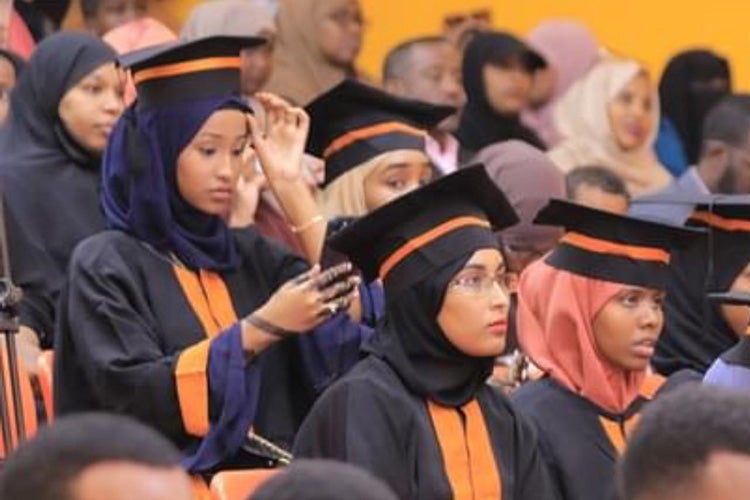
Now, as the first in her immediate family to attend university, Anshur will study computer science at U of T Scarborough. She says attending U of T is both a dream come true and a responsibility.
“I think it will convince a lot of girls [back home] to … really finish their schooling all the way because they know that, ‘Hey, there was a girl before us that got into a good university on a good scholarship,’” she says.
With a passion for computer science, Anshur plans to focus on AI and sustainability. In particular, she hopes to raise awareness about the environmental costs of the technology and ensure its benefits reach developing nations.
“Soon [AI] will be in every industry and every classroom,” she says. “Making sure that it’s not destroying our already fragile ecosystem that we are dependent on is my core mission.”
That said, she believes the technology will bring many positive changes. “It’s going to make education easier in countries where it’s really hard to come across good quality education,” she says.
Anshur first learned about U of T’s Pearson Scholarship through her school principal. Named after Lester B. Pearson, a U of T alumnus, former prime minister and Nobel Prize recipient, the scholarship covers four years of study at U of T for first-entry international students in undergraduate programs. It includes tuition, books, incidental fees and residence support. The award recognizes students who demonstrate exceptional academic achievement, creativity, leadership and a commitment to making an impact in their communities.
She applied after a gap year spent teaching and received the good news during Ramadan.
“I was like, am I dreaming? Am I even awake? I was very happy, but I was in a state of denial. I did not believe it,” she says.
Anshur says she’s looking forward to diving into campus life, exploring U of T Scarborough’s nature-filled surroundings and experiencing her first Canadian winter.
She credits her own teachers for seeing her potential and helping shape her journey – especially “teacher Ali,” who taught mathematics and physics and helped her catch up after missing months of school due to financial hardship. “Education is a very difficult profession,” she says. “It’s so demanding emotionally, physically, mentally – and I don’t think teachers and educators get the flowers they really deserve.”
Now, just as her teachers, family and peers inspired her to keep pushing forward, she hopes to inspire a new generation of Somali girls to pursue their educational dreams.
“Going [to U of T] on a scholarship, it’s breaking barriers,” she says. “I think the sense of hope and the feeling that it’s possible to get there – that’s the main benefit of me going to U of T.”
Topics
Newsletter