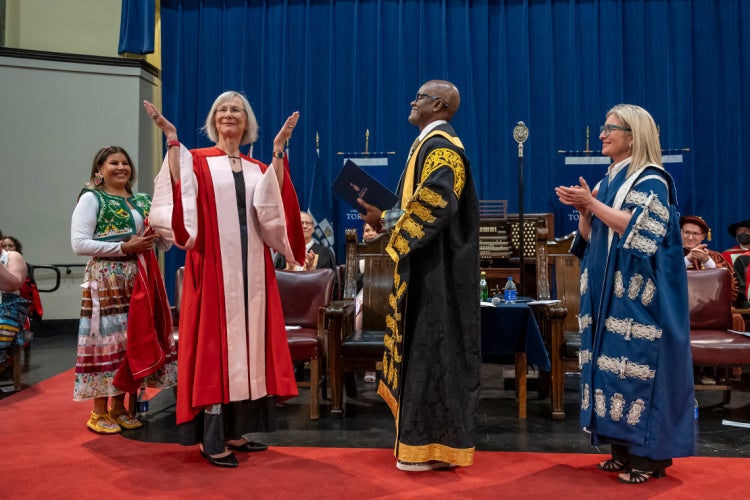
Marion Buller receives U of T honorary degree for leadership in justice and reconciliation
(photo by Lisa Sakulensky)
Published: June 3, 2026
For decades, Marion Buller has worked to make Canada’s legal system more responsive to Indigenous realities – not only by naming its failures, but also by building alternatives grounded in accountability, healing and truth.
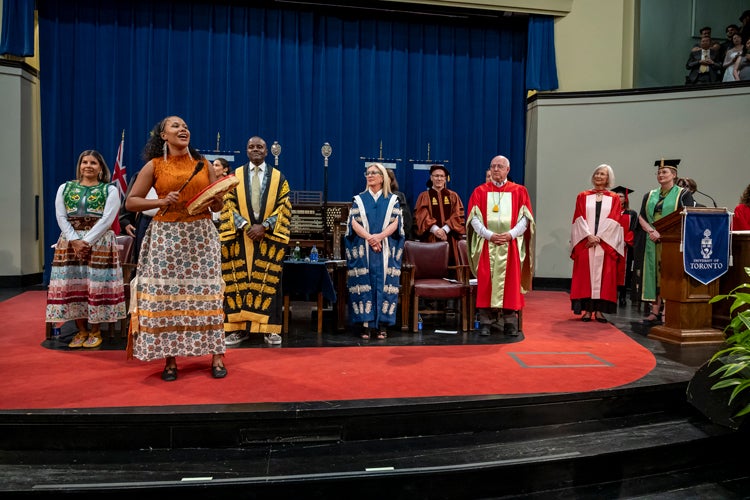
Today, in recognition of her outstanding service to the public good through her leadership in advancing justice, reconciliation and Indigenous rights, as well as her lifelong dedication to truth-telling and restorative justice, Buller receives an honorary doctorate from the University of Toronto.
A member of the Mistawasis Nêhiyawak, a Cree First Nation in Saskatchewan, Buller has been a leader in Canadian law and public life. In 1994, she became the first Indigenous woman appointed to the Provincial Court of British Columbia. Over more than two decades on the bench, she presided in courtrooms across the province and helped reshape the practice of justice for Indigenous Peoples in B.C.
Buller studied anthropology at the University of Victoria, graduating in 1975, and later returned there for law school. She has described her legal education as an “unplanned opportunity” – one sparked by mentors who, she recalled in a 2021 University of Victoria interview, “lit a fire in me.”
That spark led her into a legal career defined by institution-building. As a judge, Buller helped create the First Nations Court of British Columbia in 2006 – a sentencing court that draws on restorative justice principles and Indigenous traditions in seeking outcomes that balance accountability, rehabilitation and healing. She also helped lay the foundation for the Aboriginal Family Healing Court, aimed at supporting the return of Indigenous children to their families and communities.
In 2016, after 22 years on the Provincial Court, Buller took on what would become the most visible role of her career: chief commissioner of the National Inquiry into Missing and Murdered Indigenous Women and Girls. The inquiry heard from 2,380 people, including family members and loved ones, and survivors of assault. Its final report, Reclaiming Power and Place, examined the systemic causes of violence against Indigenous women, girls and two-spirit people.
When the report was released in 2019, Buller made clear that its findings were meant to confront Canadians, not comfort them. Its 231 Calls for Justice, she stressed, were intended to drive structural change.
Again and again, Buller has returned to the need for honesty – about colonialism, institutional failure and the difficult work still ahead. Speaking at U of T Mississauga in January 2025, she urged her audience not to retreat from hard conversations. “The worst thing you could do is stop talking,” she said.
At that same talk, Buller suggested that even the language of reconciliation can be too limited for the scale of change required. She spoke instead of “reconstruction” – a word she uses to signal the need to rebuild systems, relationships and communities, not simply repair them. “All of us, Indigenous and non-Indigenous, need to know the truth about our histories – our family histories, our community histories, and our national histories – in order to not make the same mistakes.”
Along with that insistence on truth-telling is a practical sense of what justice requires. In a 2025 conversation on the podcast Appointed, hosted by Canadian Senator Kim Pate, Buller argued that many of the harms faced by Indigenous women and girls are inseparable from poverty, child welfare interventions and systemic failures that begin long before anyone enters a courtroom. The challenge, in her view, is not only to respond to crisis, but to rethink the legal and political structures that produce it.
Since the inquiry, Buller has returned to practising law – at Miller Titerle + Company – and continues to serve in public life. She is chancellor of the University of Victoria and justice of the peace for K’omoks First Nation – the first justice appointed to serve a First Nation under its own laws.
Her honours include appointment as a Member of the Order of Canada and multiple honorary doctorates.
Topics
Newsletter