Elizabeth Dowdeswell receives U of T honorary degree for a lifetime of public service and civic leadership
(photo by Lisa Sakulensky)
Published: June 2, 2026
Over a career spanning more than five decades, Elizabeth Dowdeswell has moved fluidly from the classroom to the cabinet table to the global stage – guided by a belief in public service and the power of active citizenship.
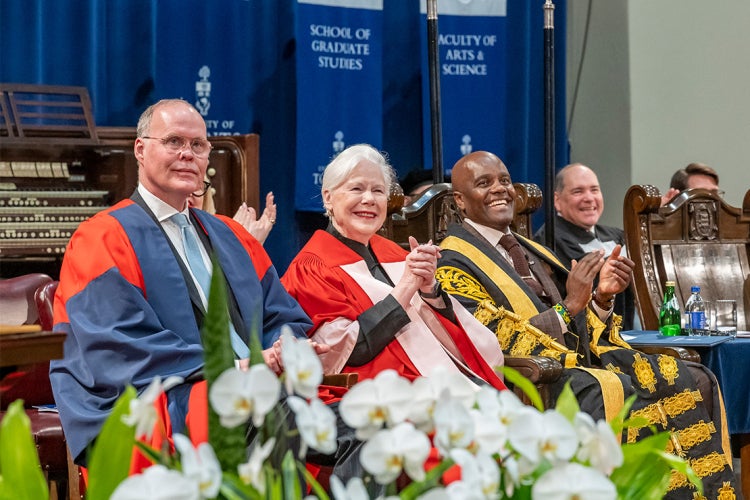
Today, in recognition of her outstanding service to the public good through leadership in civic engagement and sustainability, and for her efforts to strengthen democratic dialogue and foster understanding across communities, Dowdeswell receives an honorary doctorate from the University of Toronto.
Dowdeswell, who was Ontario’s longest-serving lieutenant-governor, approached the role as a platform for listening and connection. Over nearly a decade in office, she travelled across the province, met with thousands of Ontarians and used her position to amplify voices often unheard in public life.
Born in Northern Ireland, Dowdeswell emigrated to Canada as a child, settling with her family in rural Saskatchewan. That early experience, she later reflected, instilled values that would shape her career – a sense of community and social responsibility. She went on to earn a bachelor of science and teaching certificate from the University of Saskatchewan, followed by a master of science from Utah State University as she began her professional life as a teacher.
Her path soon shifted to public service. In 1976, she became special assistant to Saskatchewan's deputy education minister before becoming deputy culture and youth minister in 1978. Several years later, she moved to Ottawa to take on senior roles in the federal government. As assistant deputy minister of Environment Canada, she oversaw the nation’s weather and atmospheric agency and played a key role in negotiating the United Nations Framework Convention on Climate Change.
Her influence on global environmental policy expanded dramatically in the 1990s, when she was appointed executive director of the United Nations Environment Programme – the first woman to hold the role. Based in Nairobi, she contributed to global environmental governance and sustainable development.
After returning to Canada, Dowdeswell continued to lead major institutions at the intersection of science, policy and society. She served as founding president and CEO of the Nuclear Waste Management Organization, and later as president and CEO of the Council of Canadian Academies, championing the role of evidence in public decision-making.
In 2014, she was appointed lieutenant-governor of Ontario – the Crown’s representative in the province – beginning what would become a record-setting tenure. Rather than define her mandate immediately, she chose to begin by listening. She travelled to every riding in Ontario, engaging with communities large and small, and describing her role as helping people understand their place within a broader civic framework.
“Democracy is about so much more than government, so much more than casting a vote,” she said in remarks delivered at Queen’s Park in 2019. “It is about the way in which we make decisions. How we govern ourselves as a society. How we learn to live together on this planet in peace and harmony.”
That emphasis on participation became a defining feature of her time in office. Dowdeswell encouraged Ontarians to reflect on their responsibilities as citizens – not only locally, but globally – and to engage thoughtfully with complex issues, from climate change to social cohesion. She often spoke of the importance of safeguarding democratic institutions. “Our democracies appear ever more fragile,” she warned in her 2019 remarks, urging vigilance and renewed commitment to shared values.
During the COVID-19 pandemic, she reached out regularly to community leaders across the province, offering support and candid conversation. Reflecting on that period, she described in a Globe and Mail article the importance of simply asking, “So, how are you doing?” – a question she noted is rarely posed to those in leadership roles.
Throughout her tenure, Dowdeswell framed the lieutenant-governor’s role as one of steadiness and care – providing what she called “a consistent presence, stability, continuity and comfort” during challenging times.
Since leaving office, she has continued her commitment to public life, serving on numerous boards and advisory bodies, including the University Health Network, the Aga Khan Museum, the Toronto Symphony Orchestra and the Canadian Climate Institute.
Dowdeswell is an Officer of the Order of Canada and a member of the Order of Ontario, and she has received numerous awards, including 11 honorary degrees.
Topics
Newsletter